Removing a Tree From a Tight Lot Without Wrecking What's Around It
August 30, 2026
Sinkhole Risk: What Is Real vs. What Is Exaggerated
True sinkholes, the kind that open suddenly and swallow objects, are almost exclusively associated with dissolution of limestone bedrock, not root decay. Covington sits on glacial outwash soils over clay and till. There is no karst geology here. What homeowners call sinkholes in this context are soil subsidence events, which are real but predictable and manageable.
What you are actually seeing is a collapse of the loose, void-rich soil layer that formed as roots decomposed. These depressions are almost always 4 to 18 inches deep and 12 to 36 inches wide. They form gradually over weeks to months, rarely overnight, and they give visible warning signs before they become a tripping hazard.
The highest-risk zones are where multiple large roots converged, typically within 4 to 6 feet of the original stump center, and where roots ran under hardscape like walkways or driveways. A root decaying beneath a concrete path cannot be seen from the surface, but the path will begin to crack and rock in a linear pattern following the root's path once enough void space opens beneath it.
| What You're Seeing | Most Likely Cause | Severity | First Step |
|---|---|---|---|
| Circular depression in lawn, 1 to 3 inches deep | Surface root decomposition void | Low | Fill with topsoil and compact lightly, monitor for recurrence |
| Soft spongy soil over a 3 to 6 foot area | Large root mass actively decomposing | Medium | Probe depth before filling, avoid heavy equipment over zone |
| Cracking walkway in a linear pattern | Root decomposing beneath hardscape | Medium | Mark crack pattern and monitor rate of change over 30 days |
| Depression forming near foundation | Root channel directing water toward structure | High | Do not fill. Have a professional assess drainage and structural fill |
| Yellowing grass in a ring pattern | Decaying roots consuming nitrogen as they break down | Low | Apply balanced slow-release fertilizer to affected turf |
| Soil settlement under fence post | Root running beneath post base | Medium | Check post stability and repack base if more than 1 inch of lean |
| Standing water in former stump zone | Grind cavity collecting runoff without root uptake | Low | Fill cavity to grade with topsoil and compact in 2-inch lifts |
| Repeated depression in same spot after filling | Large structural root still decomposing at depth | Medium | Allow full decomposition cycle before final grade, 2 to 4 year window |
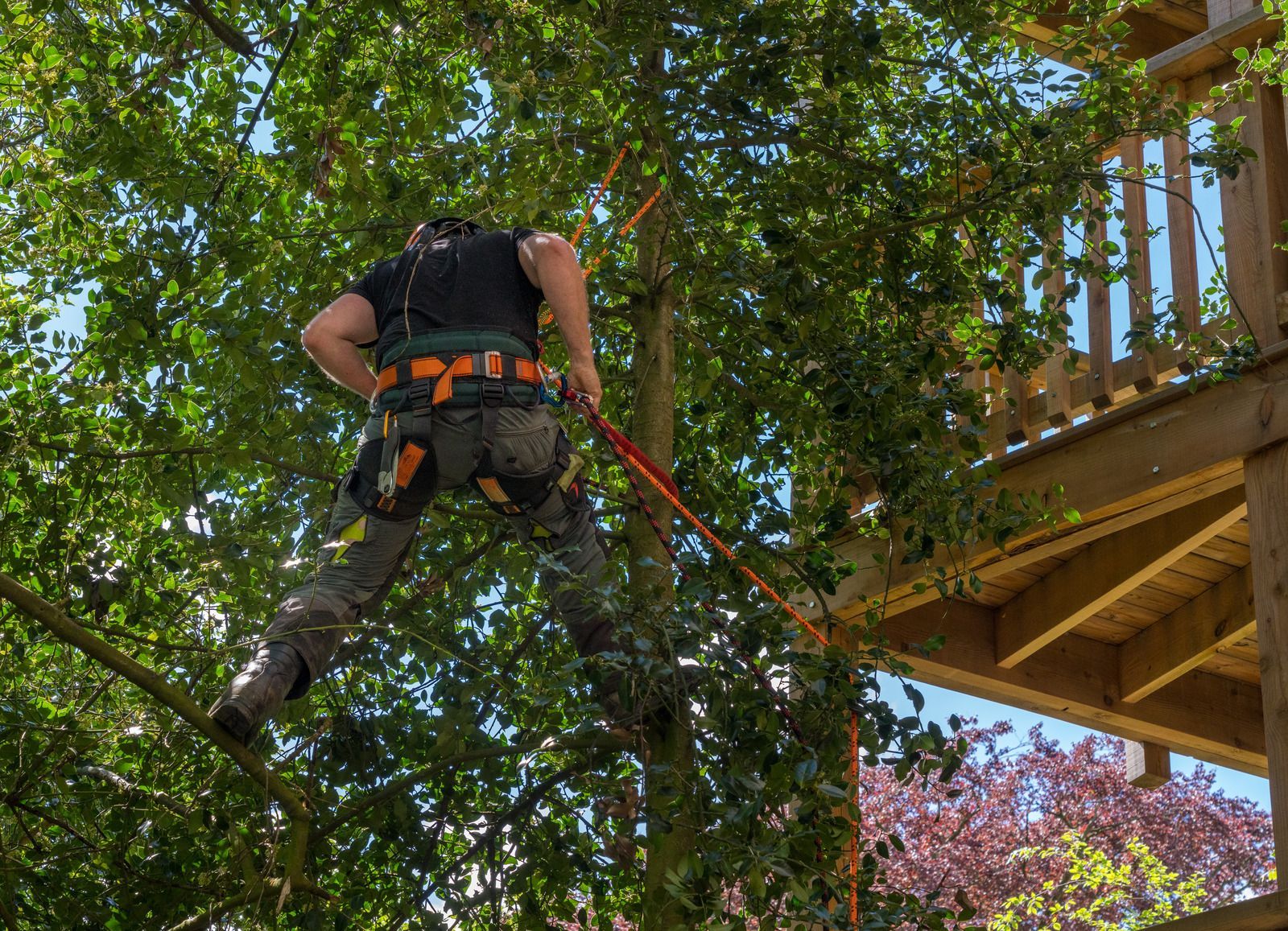
QUICK ANSWER: A tree squeezed between a house, a fence, and a neighbor's driveway can't just be felled and let fall. Crews take it apart from the top down, section by section, lowering each piece on rope rather than dropping it. The tree's lean, weight distribution, and any decay decide how big those sections can be and where the rigging point goes. Smaller cuts, controlled lowering devices, and sometimes an aerial lift replace the wide-open felling cut you'd use out in a field. Done right, a hundred-foot conifer can come down four feet from a shed without leaving a mark on it.
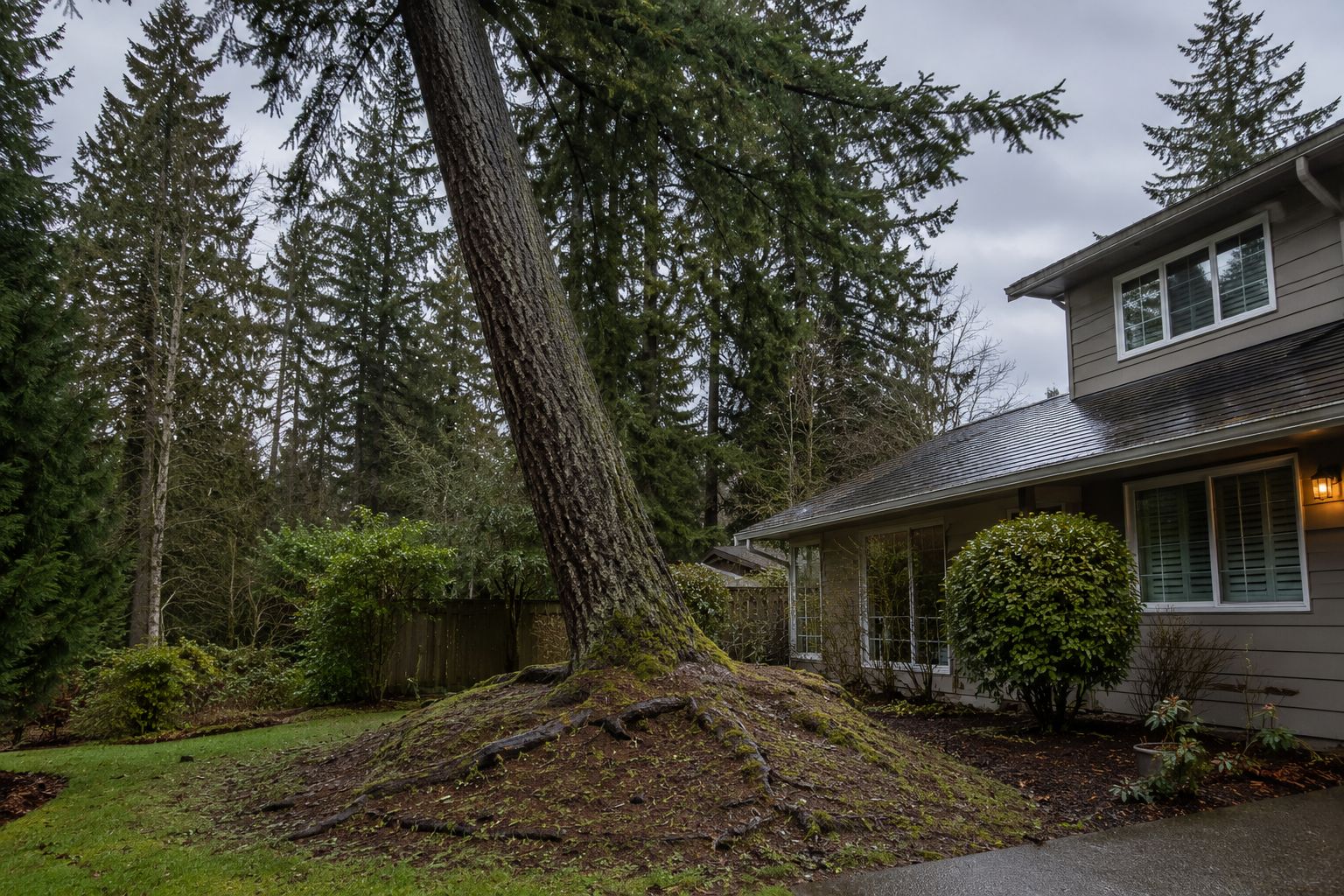
Most yards in Covington, Kent, and Auburn weren't built with tree removal in mind. A Douglas fir or big-leaf maple went in decades ago as a sapling, and now it's sixty or eighty feet tall with a house on one side, a fence on the other, and maybe a power line running along the property edge. Taking that tree down the way you'd fell one in open timber, letting it fall in a single direction, just isn't an option. There's nowhere for it to go.
That's where sectional removal comes in. It's slower, it takes more equipment, and it demands a different kind of thinking than a straightforward felling job. But it's the only real way to get a tree out of a tight spot without punching a hole in a roof or dragging a fence line down with it.
What Makes a Lot "Tight" in the First Place
Ask ten arborists what counts as a tight removal and you'll get ten slightly different answers, but the underlying math is the same. It comes down to how much clear landing space exists once you subtract the house, the fence, the shed, the neighbor's driveway, and whatever's planted nearby. A tree with sixty feet of open lawn around it barely counts as tight. The same tree standing eight feet from a garage wall is a different job entirely.
Distance isn't the only variable. A crew also has to think about what's directly below the canopy and what's off to the side, because branches don't always fall straight down. Slope matters too. A tree growing on a bank behind a retaining wall changes how weight moves once a section is cut free. So does soil that's soft from weeks of Pacific Northwest rain, which affects how stable the ground crew's footing is and how a stump behaves once the trunk comes off it.
Access counts for just as much as clearance. Can a truck and chipper get anywhere near the tree, or does everything have to be carried in through a side gate? Gated backyards, narrow driveways, and steep grades are common around here, and they shape the whole plan before a single cut happens. A tree that would take three hours in an open lot can take most of a day once you factor in hauling every section out by hand.
Reading the Tree Before Anyone Touches a Saw
Before any cutting starts, an experienced crew walks the tree the way a mechanic walks around a car before popping the hood. They're looking at species, because a Douglas fir, a western red cedar, and a big-leaf maple all behave differently once weight starts coming off. They're checking for lean, because a tree already leaning toward the house changes which side the rigging has to pull against. And they're looking for anything that suggests the wood itself isn't trustworthy: cracks running up the trunk, cavities where a limb used to be, fungal shelves at the base, or bark that's sloughing off in patches.
Weight distribution matters just as much as health. A canopy that's heavy on one side, common in trees that grew up crowded against a fence or another tree and reached for light in a single direction, will want to swing that way the second a section is freed. Cutting into wood under tension or compression, which happens often on leaning trunks and storm-stressed limbs, can cause the cut to bind or the piece to move faster than expected. None of this is guesswork. It's read from the ground, confirmed as the climber gets closer, and reassessed constantly as sections come off and the tree's balance shifts.
TIP: Walk your own yard before the crew ever shows up and take a few photos of the tree from multiple angles, including straight up into the canopy. It helps the arborist plan the approach ahead of time and gives you both a shared reference point when discussing which side branches will come down on.
Matching the Method to the Space
There's no single tool for every tight-lot removal. The right approach depends on what's around the tree and how much of it can be reached safely.
Climbing with rope and saddle is still the most common method for residential jobs, tight or not. A climber ascends the tree itself, working from natural holds and rigging points, cutting and lowering sections as they go. It's flexible enough to handle irregular canopies and odd angles that heavier equipment can't reach.
An aerial lift, sometimes called a bucket truck, trades flexibility for stability. It puts a worker in a fixed, elevated platform instead of hanging from the tree, which can speed up repetitive cuts on a straightforward trunk. The tradeoff is that a lift needs solid, reachable ground to set up on, and a lot of backyards simply don't have it.
Then there's crane-assisted removal, reserved for the trickiest jobs: a tree too compromised to climb safely, or one positioned where even a small miscalculation would mean real damage. A crane holds a section fully supported before the cut is even made, which takes the free-fall distance out of the equation almost entirely. It's more setup and more coordination, and it's usually saved for situations where the margin for error is thin enough that the extra planning pays for itself.
The Physics Behind a Controlled Drop
Here's the part most homeowners never think about: a branch doesn't just fall when it's cut loose. It swings, it rotates, it can shatter on impact, and its behavior depends on where the weight sits along its length. A limb that looks balanced from the ground might be heavier on the tip than the base, and once it's free, that imbalance decides which way it moves.
This is why rigging exists. Ropes, pulleys, and friction devices don't just lower a section, they manage the forces building inside it. A cut section suspended above the ground carries stored energy the moment it's freed, and that energy has to go somewhere. Left uncontrolled, it turns into speed and impact force. A friction device, sometimes wrapped around a lowering post at the base of the tree, lets that rope slip gradually so the piece descends at a controlled pace instead of dropping and slamming to a stop.
Shock loading is the real danger in this whole process. If a piece falls even a few feet before the rope goes tight, the sudden stop can generate forces many times the section's actual weight, forces that travel through the rope, the rigging point, and whatever that rigging point is tied to. That's part of why crews cut smaller pieces in tight spaces rather than one big section: less weight moving means less energy to control, and a smaller margin for something to go wrong.
WARNING: Never assume a limb will fall straight down, even one that looks perfectly vertical. Uneven weight, wind, and rotational force can send a cut section swinging sideways well beyond where it looks like it should land. Keep kids, pets, and vehicles well clear of the entire work zone, not just the spot directly under the branch, for the whole job.
Protecting Everything Around the Tree
A tight-lot removal is really two jobs happening at once: taking the tree apart and keeping everything else standing exactly where it was. Fences, sheds, decks, parked cars, a neighbor's garden bed, buried irrigation lines, all of it has to survive the process untouched.
Padding and plywood barriers go up before cutting starts, shielding fence tops, roof edges, and anything else in the likely path of a swinging section. Tag lines, extra ropes attached to the piece being lowered, let ground crew guide its swing and keep it from drifting toward a target it wasn't aimed at. On lots that border a neighbor's yard, that coordination matters even more, since a rigging point set on the wrong side of a lean can put weight moving in a direction nobody wants.
Overhead utility lines add another layer entirely. A line running along the edge of the property changes where a climber can safely work and which limbs get cut first, since even a section that clears the wire on the way down can still make contact if the swing carries it the wrong way. Underground lines matter too, particularly irrigation and septic systems that don't show up until equipment or a falling stump disturbs them. A quick conversation about what's buried where, before the first cut, saves a lot of headaches later.
What Happens After the Trunk Comes Down
Once the last section is on the ground, the work isn't finished. Everything gets cut into manageable pieces and cleared out, usually through whatever access point the crew used to get equipment in. On a truly tight lot, that can mean carrying rounds of wood out by hand rather than dragging a chipper up to the base of the tree.
The stump usually stays until last, ground down below grade so it doesn't leave a tripping hazard or an eyesore in the middle of the yard. Grinding close to a fence or a foundation takes its own kind of care, since the machine has to work around roots that may have grown against or under nearby structures. Once the grinding's done, the hole gets filled and the site gets raked clear of chips and debris, leaving the space ready for whatever comes next, whether that's new plantings, a patio, or just open lawn.
Frequently Asked Questions
Can a tree really come down safely just a few feet from my house?
Yes. Crews can dismantle the tree in controlled sections, rigging and lowering each piece carefully instead of allowing it to fall freely toward nearby walls, roofs, or structures.
Does a tight removal take longer than a normal one?
Usually. Smaller cuts, individual rigging, careful lowering, and limited equipment access all add time. A removal that takes hours in open space may require most of a day.
What if the tree leans toward my house?
A lean changes the removal strategy but doesn't automatically prevent safe work. Crews can use controlled cuts, rigging, and strategic weight reduction to manage the tree's movement throughout removal.
Will the crew need to access my neighbor's yard?
Sometimes, depending on the tree's location and available working space. If neighboring access is necessary, the situation should be identified and coordinated during planning before removal work begins.
How close can equipment safely get to my fence or garden beds?
That depends on the property and equipment being used. Crews can use protective materials and careful staging, while extremely confined areas may require carrying sections out by hand.
A Careful Finish for Challenging Tree Removals
Tight-lot tree removal is ultimately about control rather than speed. When a tree stands close to a home, fence, driveway, or other structure, each section has to be evaluated, cut, and managed with the surrounding property in mind. The right combination of climbing, rigging, lowering, and protective measures allows the tree to come apart in a predictable sequence instead of becoming a falling hazard. That approach helps preserve the structures, landscaping, and usable space surrounding the tree throughout the removal process.
With 30
years of experience, Ivan's Tree Removal Services
in Covington, WA brings that careful approach to residential tree work throughout the area. Every property presents different access, clearance, tree-health, and terrain conditions, so the removal method needs to fit the specific site. A well-planned sectional removal can turn an otherwise complicated tree into a series of manageable pieces, leaving the surrounding property substantially as it was before the work began.