The Ten-Minute Tree Job That Turns Into an Emergency Room Visit
September 14, 2026
Sinkhole Risk: What Is Real vs. What Is Exaggerated
True sinkholes, the kind that open suddenly and swallow objects, are almost exclusively associated with dissolution of limestone bedrock, not root decay. Covington sits on glacial outwash soils over clay and till. There is no karst geology here. What homeowners call sinkholes in this context are soil subsidence events, which are real but predictable and manageable.
What you are actually seeing is a collapse of the loose, void-rich soil layer that formed as roots decomposed. These depressions are almost always 4 to 18 inches deep and 12 to 36 inches wide. They form gradually over weeks to months, rarely overnight, and they give visible warning signs before they become a tripping hazard.
The highest-risk zones are where multiple large roots converged, typically within 4 to 6 feet of the original stump center, and where roots ran under hardscape like walkways or driveways. A root decaying beneath a concrete path cannot be seen from the surface, but the path will begin to crack and rock in a linear pattern following the root's path once enough void space opens beneath it.
| What You're Seeing | Most Likely Cause | Severity | First Step |
|---|---|---|---|
| Circular depression in lawn, 1 to 3 inches deep | Surface root decomposition void | Low | Fill with topsoil and compact lightly, monitor for recurrence |
| Soft spongy soil over a 3 to 6 foot area | Large root mass actively decomposing | Medium | Probe depth before filling, avoid heavy equipment over zone |
| Cracking walkway in a linear pattern | Root decomposing beneath hardscape | Medium | Mark crack pattern and monitor rate of change over 30 days |
| Depression forming near foundation | Root channel directing water toward structure | High | Do not fill. Have a professional assess drainage and structural fill |
| Yellowing grass in a ring pattern | Decaying roots consuming nitrogen as they break down | Low | Apply balanced slow-release fertilizer to affected turf |
| Soil settlement under fence post | Root running beneath post base | Medium | Check post stability and repack base if more than 1 inch of lean |
| Standing water in former stump zone | Grind cavity collecting runoff without root uptake | Low | Fill cavity to grade with topsoil and compact in 2-inch lifts |
| Repeated depression in same spot after filling | Large structural root still decomposing at depth | Medium | Allow full decomposition cycle before final grade, 2 to 4 year window |
QUICK ANSWER: Some trees are too dangerous to take down yourself because the risk isn't really about the cutting — it's about what happens after the cut, when a trunk under tension releases, a limb snaps back, or a chainsaw kicks toward your face. Struck-by incidents, where a person is hit by the tree itself or a falling limb, cause more deaths in tree work than any other single hazard, and falls from height and contact with power lines aren't far behind. A leaning Douglas fir, a tree with a split trunk, or anything within reach of a line or a roofline should go to a trained crew with rigging experience, not a homeowner with a ladder and a borrowed saw. Hire a pro when the tree's size, lean, condition, or location adds forces you can't predict or control.
You climb up ten feet with a chainsaw, cut halfway through a leaning alder, and the trunk barber-chairs straight up the grain toward your chest before the top half even hits the ground. That's not a rare freak accident. It's one of the most common ways backyard tree removal goes wrong, and it happens fast enough that there's no time to react.
Most homeowners who reach for a chainsaw aren't reckless. They've cut firewood before, they've watched a few videos, and the tree in question doesn't look that different from ones they've handled. What's missing isn't nerve. It's the ability to read a tree the way a crew that does this every day can — the lean, the internal tension, the way the wood is going to move once you release it from the trunk. That gap between what a tree looks like and what it's actually going to do is where people get hurt.
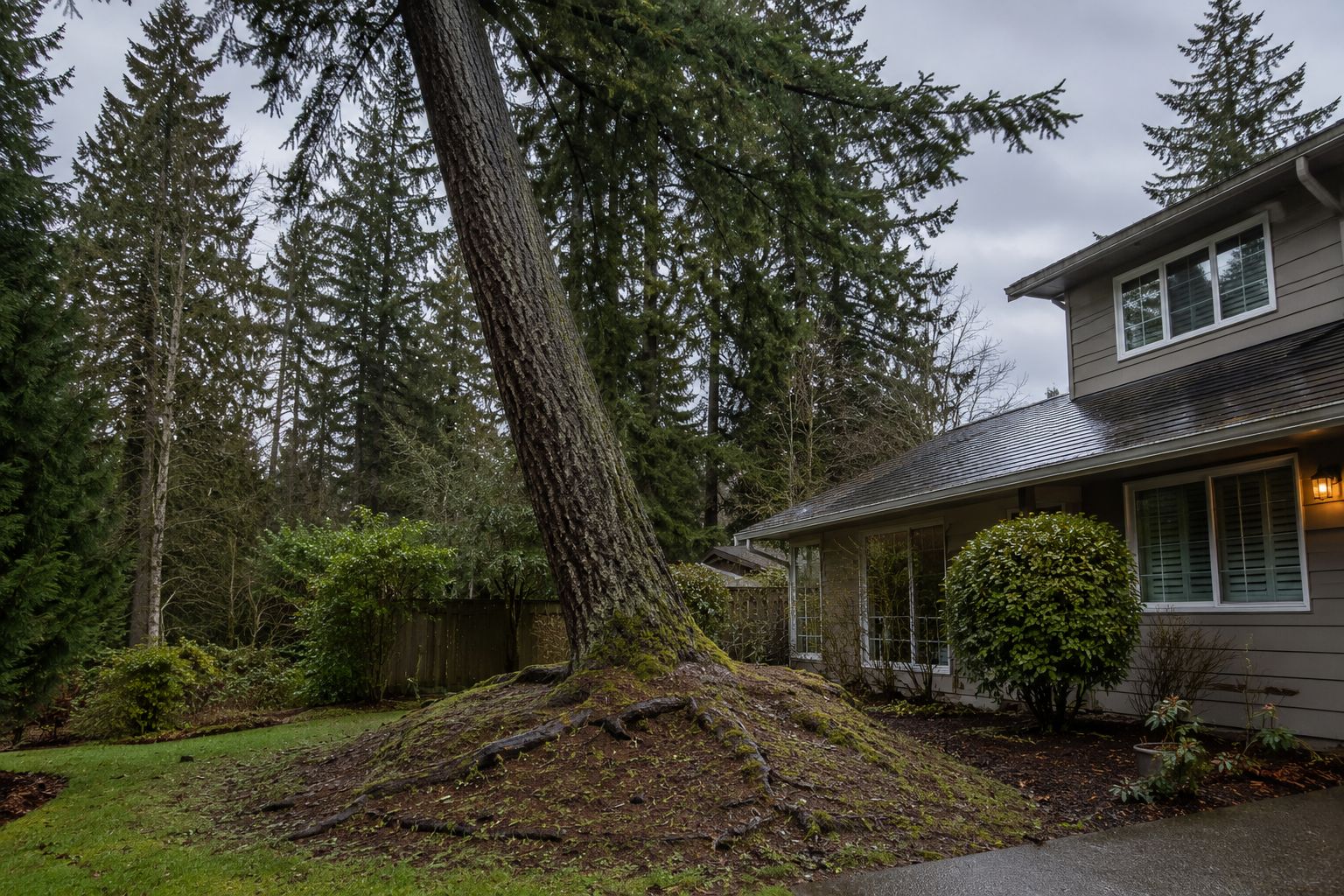
The Lean You Can See Isn't the Risk You Can't
Every tree stores energy. Wind, growth pattern, and years of leaning toward light all put wood under stress you can't see from the ground. Cut into that wood in the wrong spot and you release all of it at once, often in a direction nobody standing nearby expected.
Reaction Wood
Trees growing on a slope, next to a fence line, or crowded by neighbors often develop reaction wood — denser growth on one side that compensates for lean. That wood is under compression or tension long before a saw touches it, and a cut in the wrong place lets it spring, twist, or split violently.
Barber-Chairing
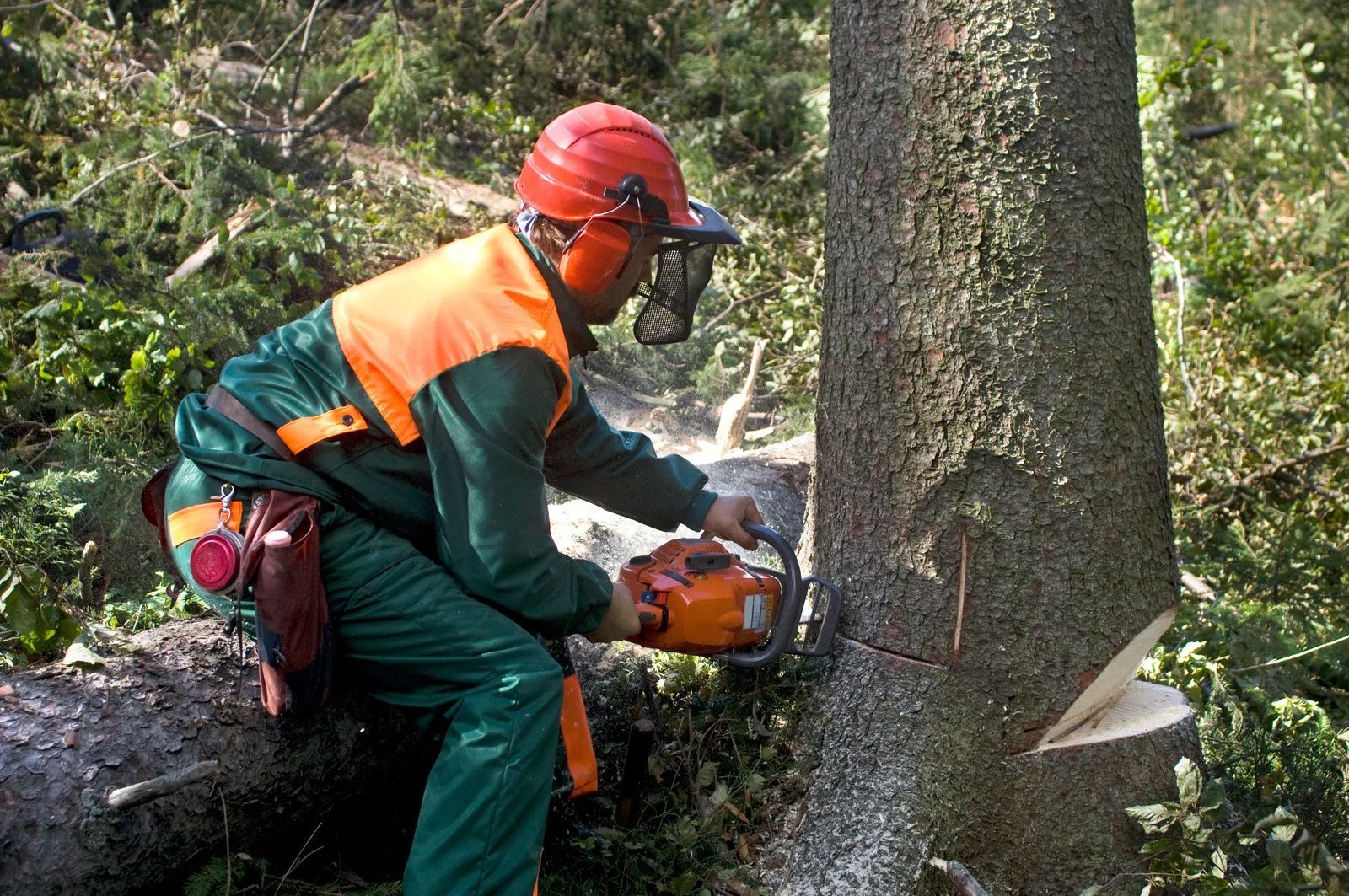
This is what happens when a leaning tree's fibers separate up the trunk instead of falling cleanly at the cut. The top of the tree can kick backward into the person making the cut before the tree even starts to fall in the intended direction. It's one of the more violent tree-felling accidents on record, and it's almost always tied to an undersized or improperly placed felling cut on a tree carrying more forward lean or wind load than the person cutting it accounted for.
Codominant Stems And Included Bark
Big-leaf maple and some ornamental trees commonly grow with two trunks fused at a narrow, weak angle. That union can hold for decades and then fail without warning under wind or added weight — and a homeowner cutting near one has no way to know from the outside whether the wood inside is sound or already cracked.
Trained crews don't guess at any of this. They read the lean, tap and probe the wood, and account for stored energy before the first cut goes in — because a tree that looks stable from the driveway can be holding tension that only shows itself once it's released.
Rigging, Kickback, and the Math Crews Do Before the First Cut
A chainsaw is the tool most people picture when they think about tree removal danger, and it deserves the attention. Kickback happens when the tip of the guide bar touches a branch, the ground, or another piece of wood, snapping the saw backward and upward toward the operator's head and shoulders in a fraction of a second — far faster than most people can react. It's a documented cause of serious lacerations even among people who've run a saw for years.
But the part homeowners underestimate more is what happens after the cut, when a section of trunk or a heavy limb is coming down and something has to control where it lands. Removing a tree near a house, a fence, a shed, or another tree usually means the wood can't just be dropped — it has to be lowered on rope, and that's where the physics get unforgiving. A cut section of wood generates dramatically more force in freefall than its static weight suggests, and if the rope, the rigging point, or the anchor branch isn't rated and positioned for that load, something gives. Sometimes it's the rope. Sometimes it's the branch the rope was tied to, and that branch — or the person standing under it — comes down with the load.
This is also where inexperience compounds fast. A misjudged notch cut, a hinge that's too thin, a lowering line anchored to a limb that can't actually take the strain — any one of these turns a controlled removal into an uncontrolled one, and there's rarely a second chance to correct it mid-cut.
TIP: If a tree has any lean, split, or lower limbs over 4 inches thick, treat rigging as a job requirement, not an option — trying to drop sections freehand near a structure is where most property damage and injuries happen, even on trees that otherwise look manageable.
Power Lines and Structures Change Every Calculation
Add a power line, a roofline, a fence, or a neighbor's yard to a tree removal and the margin for error shrinks to almost nothing. A tree or a branch doesn't need to fall directly onto a line to cause a problem — contact happens through a chainsaw bar, an aerial ladder, or even a rope thrown over the wrong branch, and electricity doesn't care whether the person touching the line meant to.
Distance is also harder to judge than it looks. A branch that appears to clear a line by several feet from the ground can be much closer once it starts moving, bending, or falling in a direction the person cutting didn't anticipate. Around Covington, Kent, Auburn, and the rest of the south Puget Sound, plenty of yards have overhead service lines running close to mature Douglas fir and cedar canopies, and those trees only need to shift a little during a cut to make contact.
Structures complicate the math the same way. A tree leaning toward a house, garage, or deck has to be dropped with enough precision that a two- or three-inch miscalculation in direction doesn't matter — and getting that precision usually requires directional felling techniques, tag lines, or full sectional dismantling rather than a single cut and a hope that gravity cooperates.
WARNING: Never attempt to remove, prune, or even climb a tree that is touching, leaning toward, or growing within ten feet of a power line. Contact with an energized line can be fatal, and the risk doesn't go away just because the line looks insulated — most overhead residential lines are not. If a tree on your property is anywhere near service lines, that job belongs to a crew trained to work around them, full stop.
How We Read a Tree Before We Ever Touch a Saw
Every removal starts with a walk-around, not a chainsaw. We look at the lean and compare it to where the tree needs to end up, check the base and root flare for signs of rot or lifting soil, and look up into the canopy for dead wood, cracks, or codominant unions that change how the tree will behave once weight starts coming off it. Thirty years of doing this across Covington, Maple Valley, Kent, Auburn, and the surrounding area means we've seen how Douglas fir behaves in a windstorm, how a big-leaf maple with included bark tends to fail, and how saturated winter soil changes a root plate's ability to hold a tree upright — none of which shows up in a quick look from the sidewalk.
From there, we plan the sequence: what comes down first, where each section gets rigged, how it gets lowered, and what stays anchored until the last cut. On a tight lot or anywhere near a structure, that often means sectional dismantling — taking the tree apart from the top down in controlled pieces instead of felling it whole. It's slower. It's also the difference between a removal that goes exactly as planned and one that doesn't.
We also account for what the ground is doing. Heavy rain and saturated soil are part of life here for months at a time, and wet ground changes how a root system holds, how equipment can move around a yard without tearing it up, and how much force a rigging anchor can actually take before it shifts. None of that gets factored in by eye — it gets factored in by crews who've worked through enough wet Northwest winters to know what the soil is telling them.
Frequently Asked Questions
How do I know if a tree is too dangerous to remove myself?
A visible lean, split trunk, dead limbs overhead, or power line contact all call for a professional crew. Size matters too, since a falling section reaching a structure or fence line needs rigging most homeowners don't have.
Is chainsaw kickback really that dangerous?
Yes. Kickback drives the saw backward and up toward the operator in a fraction of a second when the bar tip strikes something unexpected, causing deep lacerations even through protective gear, and it can happen to experienced users just as easily as beginners.
Why do trees near power lines need a professional even for a small trim?
Distance is deceptive once a branch starts moving. A cut limb can swing closer to a line than it appeared, and contact through a saw, ladder, or rope can be just as dangerous as the tree touching the wire.
What makes Pacific Northwest trees carry more removal risk than trees elsewhere?
Douglas fir and western red cedar grow tall fast with heavy, wind-loaded canopies on shallow roots in seasonally saturated soil. Winter rain softens the ground further, reducing anchorage right as storm season increases wind load.
Can a tree that looks healthy still be dangerous to cut down?
Yes, and this catches people off guard. Full green foliage can hide internal decay, included bark, or stored tension from years of lean. Looking sound on the surface doesn't mean the tree is predictable once a cut releases that stress.
What should I do if a tree on my property needs to come down?
Start with an assessment rather than a removal plan. A trained eye can tell whether the tree needs a simple cut or a rigged, sectional approach, and that read beats the guesswork of a miscalculated cut gone wrong.
Knowing When a Tree Job Isn't a Solo Job
The ten-minute job that turns into an emergency room visit rarely starts with bad luck. It starts with a tree that looked simple from the ground and turned out to be holding tension, decay, or a lean nobody accounted for. Reading that risk correctly takes more than confidence with a chainsaw; it takes having watched hundreds of trees behave under a cut, in wind, and through a wet Northwest winter, which is exactly the kind of judgment a single afternoon of research can't replace.
Ivan's Tree Removal Services
has spent 30
years working through that judgment call for homeowners across Covington, WA, and the surrounding areas. Every removal still starts the same way it always has: a walk-around, a read of the lean and the wood, and a plan built before the saw ever touches bark. That process is what keeps a tree that gives you pause from turning into the kind of afternoon nobody planned for.